The challenge
Coaches spend hours observing players, but that knowledge often exists only in their heads. When a coach leaves, the information leaves with them. Parents ask for feedback, but there is no structured overview. And the technical committee lacks the data to make well-founded decisions about selections and progression.
The solution: Player development system
The player development system offers a structured assessment framework that lets coaches evaluate players on several dimensions. Think of the TIPS model for football (Technique, Insight, Personality, Speed) or Technical-Tactical-Mental-Physical for other sports. This makes player development part of your club management software, rather than a separate process alongside your member records and team selection.
Configurable forms
Set up your own categories and criteria, or use sport-specific templates that are ready to go.
Visual radar charts
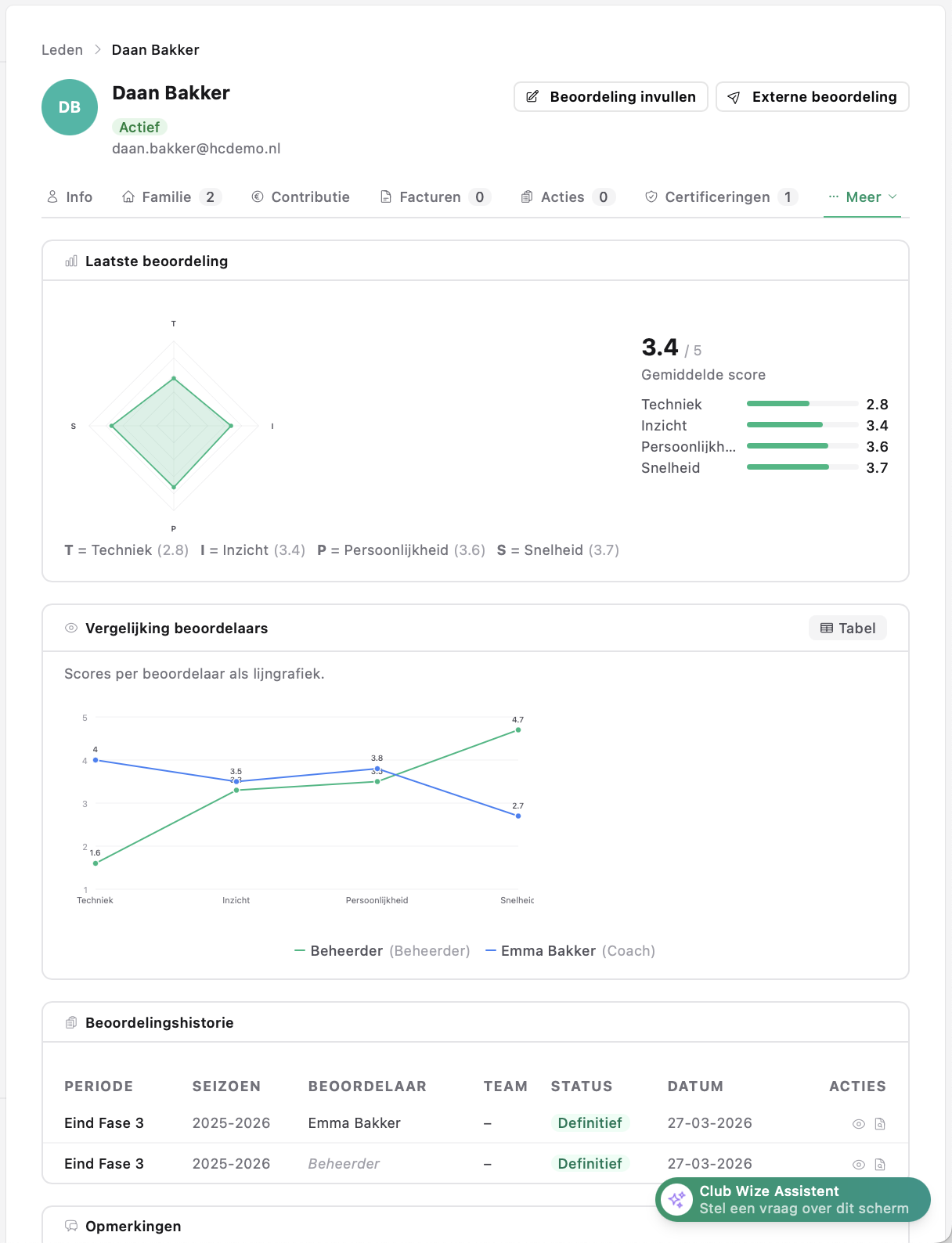
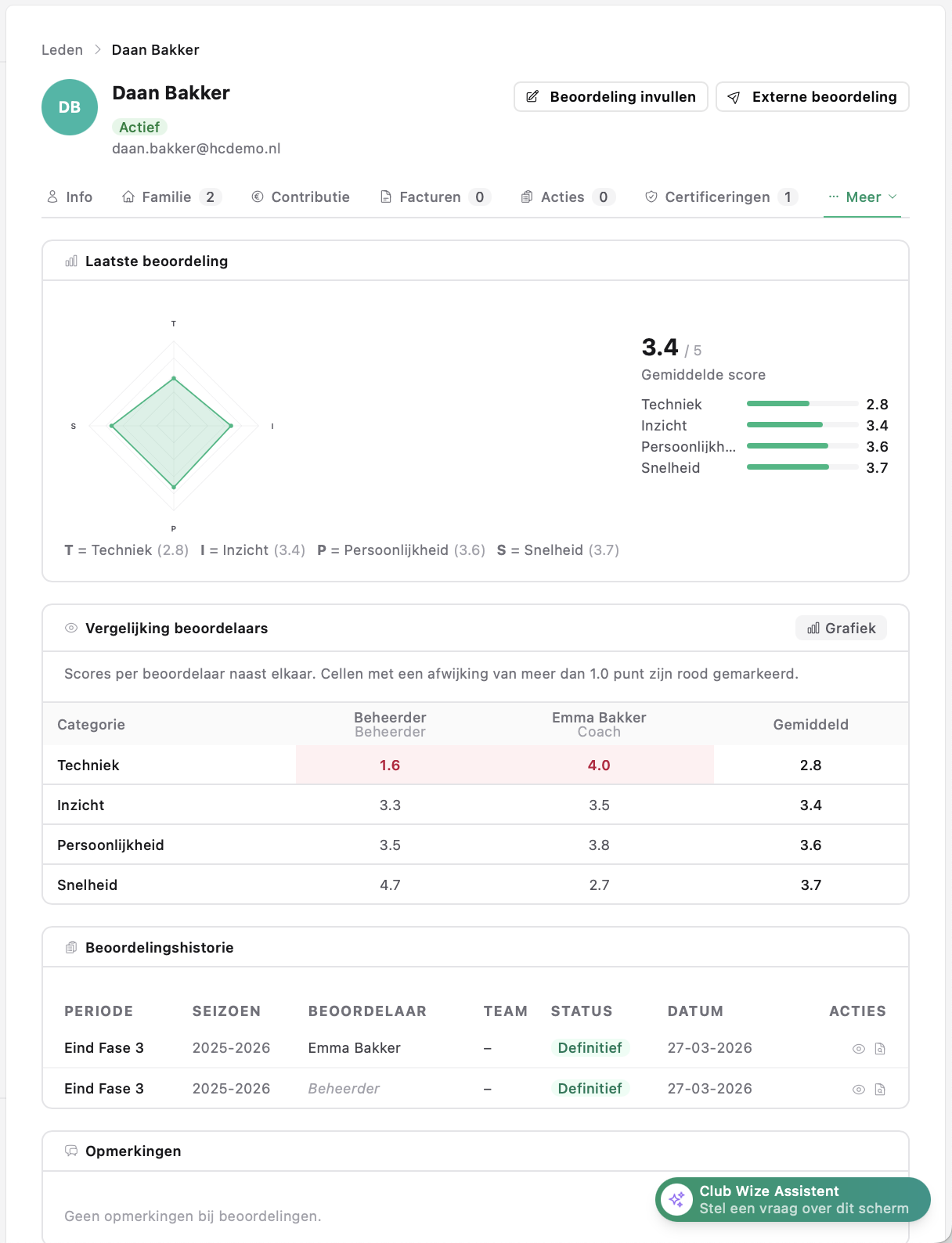
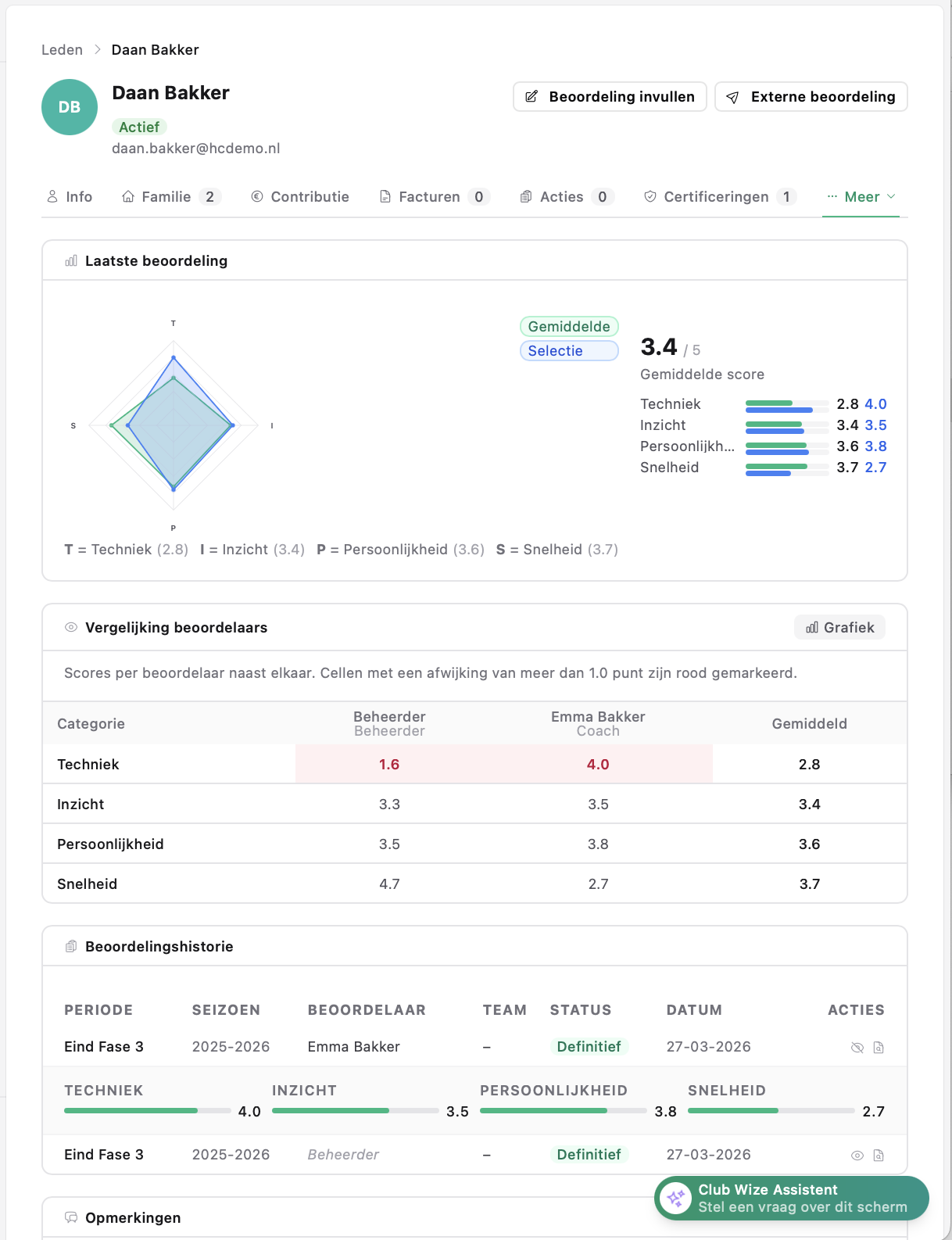
See at a glance how a player scores on every dimension, with clear radar charts.
Assessment periods
Work with periods so you can track and compare development over time.
Coach portal
Coaches fill in assessments easily via their own portal, without access to the whole system.
Fully adaptable to your sport
The system comes with ready-made templates for popular sports (football, hockey, volleyball, handball, badminton, tennis), but you are not limited to these models. You can build entirely your own forms with your own categories and criteria. Use the TIPS model, TTMF, or come up with your own structure — the system adapts to your assessment philosophy, not the other way round.
Each criterion within a category can be set individually: name, description, and whether it is mandatory. This lets you set up a different form for each sport or age group, with exactly the criteria that are relevant to your club.
Not just coaches — everyone takes part
Besides coaches, external scouts can also assess players via a secure link — without an account and without access to the system. Handy for guest coaches, trial or selection sessions or working with other clubs.
And with self-assessment, players fill in an evaluation of their own development. Coaches see it next to their own assessment, which leads to valuable conversations about self-awareness and expectations.
More than a coach score
A radar chart alone gives one perspective — that of the coach or scout, at one moment in the season. The player development system adds three further layers that make the picture more complete:
Personal development (POP) meetings
Structured one-to-one development meetings using a chosen method — STARR, GROW, 4G or the KNVB format. The player fills in a self-assessment beforehand, the coach leads the meeting via the portal, and the summary and agreements are recorded in the file.
Physical tests
Objective measurements — 30m sprint, Cooper test, beep test, strength — with automatic detection of personal bests and a trend line per player. The coach can quickly enter several players at once on their phone, from the touchline.
Training attendance
Attendance for each training session or match, recorded via the coach portal or the iOS app. Season totals on the member dashboard show patterns straight away — such as absence just before a match.
For the youth coordinator, the Player Development module also includes a staff monitor: an overview of all coaches and trainers with their qualifications, certificate of conduct status and 360° reviews (in which coaches, colleagues and players give feedback). One place to see who holds which licence, when a certificate of conduct needs renewing, and how the staff rate themselves and each other.
The player file — everything on one timeline
All those sources — assessments, personal development plan (POP) meetings, physical tests, attendance, coach notes — come together in the player file: one page per player with a vertical timeline of everything that has happened around them. Does a coach change mid-season? The file stays. Does a player move up to a higher team? The new coach opens the file and has the context within a minute.
The player file also shows more recent context signals, such as the relative age within the team and the quarter distribution of the team they play in — part of the broader relative age effect report in Teams reporting. This puts an outlier in a physical test straight into context: a top score on the 30m sprint from a player who happens to be the oldest in their team reads differently from the same score by the youngest.
How it works in practice
The technical committee sets up an assessment form with the relevant categories and criteria. Then an assessment period is opened — for example "Autumn competition 2025". Coaches get access via the coach portal and rate their players on each criterion on a scale of 1 to 5.
The results are automatically turned into visual radar charts. You can see straight away where a player excels and where there is room to develop. Scores from different assessors are compared, and differences of more than 1 point are flagged automatically — so you spot straight away where assessors disagree. When a new assessment period starts, you can compare progress over time.
Screenshots from practice
Click an image to enlarge it. Use the arrow keys to navigate.
At last we have a structured overview of how our youth players are developing. When a coach changes, we no longer have to start from scratch.
Result
Clubs using the player development system report that they have better conversations with players and parents, make well-founded decisions about selections, and that knowledge about players is retained — even when a coach leaves. The transferability at the heart of Club Wize really comes into its own here. Precisely because player development sits in the same club management software as teams, attendance and coach access, the context stays with the club rather than in scattered notes.
Key benefits
- Structured assessments instead of scattered notes
- Visual radar charts for instant insight
- Personal development (POP) meetings using STARR, GROW, 4G or the KNVB format
- Objective physical tests with personal-best detection and trends
- Training attendance with season totals
- Staff monitor with qualifications and 360° reviews
- Central player file — timeline across all sources
- Knowledge is retained when coaches change
Share this story
Curious what Clubwize can do for your club?
Book a demo and find out how to make your club future-proof.